S.Bamila
M.V. Centre for Diabetic Foot Care, Podiatry, Research & Management
This is a set of six foot exercises to be done while you are sitting on a high seat with feet not touching the ground.
1. Bend toes down. Try to keep toes straight. You can use your hand to help position the toes or get someone to help you.
2. Raise ankle up, but keep toes down.
3. Relax the toes.
4. Flex toes down and at the same time flex ankle down. Feel a squeeze in the arch.
5 . While keeping toes flexed, move the front of the foot inward (inversion)
6. Then move the front of the foot outward (eversion). Relax.
Repeat steps 1-6
DO these FOOT EXERCISES with feet on the ground.
1. Exercise position: Sit in a chair with feet flat on the floor. Raise toes off the floor several times. Keep the ball of the foot on the floor. This exercise is important for walking and helps to keep up the normal range of movement of the toe joints.
2. Exercise position: Sit in a chair with feet flat on the floor. Slide the foot back under the chair. Raise the heel, while keeping the ball of the foot and the toes on the floor. This exercise stretches tight muscles under the foot and maintains normal range of motion of the toe joints.
3. Exercise position: Sit in a chair, with feet flat on floor. Keeping the feet and toes flat on the floor, press the toes into the floor. Keep them as straight as possible. Do not allow them to curl. This strengthens the small muscles of the toes.
4. Exercise position: Sit in a chair, with feet hanging loosely. Spread the toes far apart then squeeze together as tightly as possible. After some practice, you can put a wide rubber band around your toes and spread them against resistance, further increasing strength of the small muscles. 
5. Exercise position: Sit in a chair, with feet flat on the edge of a bath towel or newspaper. Curl the toes and draw the towel/ newspaper under the foot. As you get stronger, add a weight to the other end of the towel/ newspaper. This exercise strengthens intrinsic muscles.
6. Exercise position: Sit in a chair. Place a marble on the floor, and pick it up with your toes. This exercise strengthens the small muscles of the toes.
7. Exercise position: While standing, hold lightly onto a counter top or sturdy chair for balance. Rise up onto the tips of the toes, then rock back onto the heels, lifting the toes off the floor at the same time. Do this several times. This can also be done while sitting.
This exercise improves balance and leg strength when done standing and increases foot and ankle movements and strength of the muscle.
It is important to keep this muscle strong and your ankle flexible so that you can pick up your toes when you walk, and avoid tripping.
8. Exercise position: Sit in a chair. Straighten one knee and bend the ankle. Point the toes toward the knee and feel the stretch of the calf muscle . Repeat 4 times on each leg, alternating legs. This exercise prevents cramps in the lower leg.
9. Exercise position: Sit in a chair. Move your feet as if you are writing alphabets in the air.
Friday, November 18, 2011
Exercises to Strengthen Muscles of the Feet


Wednesday, November 9, 2011
World Diabetes Day

Mrs. Sheela Paul
World diabetes day is celebrated on 14th of November of every year around the world, to raise primary global awareness among people about diabetes. It was introduced in 1991 by the International Diabetes Federation and the World Health Organization in response to the alarming rise of diabetes around the world. World Diabetes Day is a campaign that features a new theme chosen by the International Diabetes Federation each year to address issues facing the global diabetes community. While the campaigns last the whole year, the day itself marks the birthday of Frederick Banting who, along with Charles Best, first conceived the idea which led to the discovery of insulin in 1922
Each year, World Diabetes Day is centered on a theme related to diabetes. Topics covered have included diabetes and human rights, diabetes and lifestyle, diabetes and obesity, diabetes in the disadvantaged and the vulnerable, and diabetes in children and adolescents.
For 2009–2013, the theme is Diabetes Education and Prevention.
World Diabetes day is celebrated worldwide in more than 160 countries, all member States of the United Nations, healthcare professionals and many more.
The logo of the World Diabetes day is represented by a blue circle. This blue circle resembles to the global symbol of diabetes and signifies the unity of the global diabetes community in response to the diabetes pandemic.
In large towns and metro cities, most of the people don’t eat healthy food, and also doing very less exercise, that may be the major reason of this disease. By taking proper healthy diet and regular exercise will help to control Diabetes. But frankly telling there is no permanent cure for Diabetes.

There are lots and lots of activities organized on this day. These activities includes Radio and Television Programs, Poster Awareness Campaigns, Social Exhibitions, Lightings at monuments and homes, Press Conferences, Diabetes Workshops, Screening of Documentaries films on Diabetes, Public Meeting to distribute information to general public, Sports events or Cycle Racing, Special events or activities for children and Newspaper or Magazine Articles. Every Year, this World Diabetes Day activity is center around the topics that related to diabetes.
About 285 million people from all over the world are affected by Diabetes and it is also expected that this figure may rise up to 435 million by year 2030 if no action implement to stop Diabetes. Generally, it is believed that only aged people suffer from Diabetes but several studies and instances proved that the disease does not limited to any age, anyone can be affected by Diabetes.
World Diabetes day is a call to all those who are responsible for Diabetes care and can contribute to control it. For a diabetic patient, this is a message for empowerment education so that he can follow proper ways whether diet food or exercises to improve his health. For Doctors or healthcare professionals this is an alert to improve knowledge so that proper cure can be discovered. For government, it is a time to implement proper policies for prevention of diabetes. And for general public this is a call to be alert against Diabetes and understand the serious impact of diabetes. 

However, if you have diabetes, you also can live a normal, productive life. It's important, though, to monitor your diabetes and be active in taking good care of your health by recognising its symptoms properly at the right time. In last, we would like to add ‘Prevention is better than cure’, as there is no need for any cure if we take proper steps and stay away from these kind of diseases through proper prevention.
Tuesday, November 1, 2011
Socio-Cultural Changes and Diabetes
With India being dubbed the ‘Diabetes capital of the world’ it is necessary to understand the reasons that contribute to it, the changes it brings about in an individual’s life and explore ways to tackle them.
Great social and cultural changes have taken place in our society. The relatively simple and austere life style of our forefathers has given way to a lavish one where there is no limit to what money can buy.
People don’t exert themselves. The benefits of labour- saving devices and automated transport have forced people to reduce their levels of physical activity.
Easy access to mass produced refined high calorie foods which are affordable and heavily advertised have resulted in an increase in food consumption which is far more than what the body needs.
The fast pace of modern life ,changing values , longer working hours, and changes in family responsibilities have adversely influenced eating patterns and time spent on recreation and outside activities.
As a result, life style diseases such as diabetes, cardiac conditions, obesity, and circulatory problems are fast approaching epidemic proportions.
The three most important risk factors for Type 2 diabetes are sedentary life style,

poor dietary habits 

and , the ensuing changes in body composition.
These are risks that can be avoided.
A person with diabetes has to get used to changes in lifestyle, has to adhere strictly to the treatment and also has to be prepared for the onset of diabetes related complications. So, prevention is better than cure.
Changes in the life of a T2DM
High blood glucose levels and poor control can result in medical complications such as cardio-vascular diseases, retinopathy, neuropathy, and nephropathy.
Apart from that, it can influence many areas of a person’s life – changes in the daily routine due to activities focused on adequate blood glucose control, ability to work, impact on other members of the family, quality of life, sexual functioning and so on.
Diet and exercise, blood glucose monitoring, timing and dosage of oral medication or insulin, hypo management and prevention, foot care, sick day management, visits to the doctor,
medical checks and education activities
– all these have to be integrated into the normal day-to-day activities of people with diabetes.
In addition, they may have to tackle unexpected crises.
In most cases, Type 2 diabetes shows up in middle adulthood. This is a time when behavior patterns of an individual are firmly set and changes for self- care have to be made to improve blood glucose control and to slow down the advancement of diabetic complications. It may require a lot of effort to make the necessary changes. It is difficult to make changes to food habits and even more challenging to maintain them.
During the time before complications set in or during the early period of complications, many people do not show symptoms. Unpleasant symptoms such as slow healing wounds or ulcers, thickening and narrowing of arteries, tingling or burning sensation in hands, legs and feet, protein in urine, or poor vision are usually followed by an awareness and fear of the seriousness of the disease . When they are absent, the patient is not motivated enough to make the necessary lifestyle changes. In short, they treat diabetes quite lightly.
Diabetes - related emotional distress
People with diabetes often experience emotional distress while living with diabetes and the effect of its complications. Many are afraid of living with diabetes and might get depressed at the thought of it. The cost of treatment is also a source of worry. Most often they worry about the future and the possibility of diabetic complications. They are constantly concerned about food and eating and feel deprived when they cannot eat what others can. They are also concerned if changes in their moods/feelings were related to diabetes.
A short tool, the PAID (Problem Areas in Diabetes ) Scale, (Psychosocial issues and Type 2 Diabetes – Gary W Welch, Katie Weinger and Alan M Jacobson), can be used to check high emotional distress related to life with diabetes. It consists of a set of twenty questions to be answered on a 5- point scale ranging between ‘not a problem’ to ‘a serious problem’.
A score above 50 shows a high level of emotional distress. Questions which score 4 on the scale indicate areas the patient finds difficult and may be’ hot- spots’ which are causing heightened emotional stress and might need professional attention.
Good listening is good for diabetes management. 
Talking to people with diabetes about how they feel , and about the practical barriers they face for good diabetic self care is very important. Good listening increases the therapeutic bond and is good for diabetes management. Giving the patient a chance to talk about how he feels about his condition; being open, supportive and non-judgmental; using open- ended questions where the patient can provide information about feelings, instead of closed questions with yes/no answers; not interrupting or sharing personal views while the patient is talking; being aware of the patient’s body language(tone of voice, facial expressions use of hands, body posture, pauses, hesitations during difficult moments); maintaining good eye contact; using small encouraging body signals- nods, yes/no/ummm… are of great value to both physician and patient.
Briefly summarizing what you have heard, and checking with the patient whether what you heard is accurate at the end of the conversation is also essential.
A patient will feel less stressed once he has expressed his fears and hopes and will be motivated to make the necessary behavioural changes.
The greatest challenge in tackling T2DM is to focus on social and cultural changes and reverse the current trend through sensible, preventive strategies.
To control this growing problem , we need to prevent obesity as early in life as is possible , and this can only be done through a strong interaction between policy makers, medical fraternity and the individual.
Reference:
Gary W Welch; Katie Weinger; and Alan M Jacobson. "Psychosocial issues and Type 2 Diabetes." In Textbook of Type 2 Diabetes, Edited by Barry J Goldstein and Dirk Muller-Weiland. London, Martin Dunitz : 65-76; 2003.
Monday, October 24, 2011
Sweet Deepavali for diabetic and their family
- Nutrition Department
Deepavali is a major Indian festival celebrated by Hindus, Jains and Sikhs across the globe as the “Festival of Light,” where the lights or lamps signify victory of good over the evil within every human being. This festival is celebrated with joy and charm that is unmatched in celebration with any other festival.
Deepavali, as it is popularly called, is the festival of lights as “Deepam” mean lamp and Oli light. Both words when combined forms the word Deepavali. It symbolizes the victory of righteousness and the lifting of spiritual darkness. The word Deepavali literally means rows of clay lamps. It is celebrated on the New Moon day of the dark fortnight during October-November. It is also associated with the return to Ayodhya of Lord Rama, his wife Sita and His brother Lakshmana after their fourteen-year sojourn in the forests. The day also marks the coronation of Lord Rama.
Lord Krishna waged a fierce battle and killed the demon. When the evil Naraka was finally killed by Bhagwan Krishna and Satyabhaama, he begged pitifully for mercy; thus, upon his entreaties, Bhudevi declared that his death should not be a day of mourning but an occasion to celebrate and rejoice. Since then, Deepavali is celebrated every year with lots of fun and frolic and fireworks.
Deepavali is not just a festival for worshipping Goddess Lakshmi, eating sweets, wearing new clothes or lighting ghee lamps. There is a great secret significance of this festival and understanding it can enable one to celebrate the festival in the best possible manner. Diyas, candles and crackers add light to the festival, rangoli add colours and sweets and other delicious savouries add flavour to this festival. 
You relish the delicacies but later on regret. Heart burns, gastric troubles, indigestion, high blood pressure, elevated blood glucose levels, weight gain…all are some of the after effects of Diwali celebrations. These problems may tarnish your festival spree especially those who are diabetic.
To keep blood glucose level normal, even after eating sweets, he/she as to substitute small portions of sweet for other carbohydrates containing foods in the meals and snacks. For example, if a person wants to have sweet in a meal, then he should replace any other carbohydrate content of his meal. The total amount of carbohydrate ingested during the meal will remain the same.
Though, the sweets does not provide any important vitamins and minerals, they may be high in fats and calories but while including them in the meal plan one must make sure that it provides necessary nutrients.
Person, who likes sweets & desserts, can try these tips
(a) Eat a small serving of the favorite dessert, instead of something common.
(b) Satisfy your sweet tooth with fresh or dry fruits.
(c) Share desserts with your friend or family member.
(d) Reduce the amount of sugar or fat in your favorite recipes.
(e) Choose low calorie and low fat desserts.
So, enjoy this Diwali with the scrumptious delicacies without cutting out anything from your menu. Just a little change in the preparation method and you get the same but much healthier recipe to relish on. Here are some low-calorie yummy but healthy recipes...
FRUIT PUDDING
INGREDIENTS:
(Note: You can Serve this for 4)
1. ¼ cup water.
2. 1 heaped teaspoon gelatin
3. ½ cup pineapple tidbits
4. 1 apple, chopped
5. 4 dried apricots, chopped
6. 2 cups curd made from fat-free milk, whisked.
7. A few drops vanilla essence.
METHOD:
1. Heat water in a small pan over low heat. Sprinkle in gelatin and remove from heat. Set aside for about 10 minutes, stirring occasionally till gelatin is dissolved.
2. Place dissolved gelatin, pineapple, apple, apricots, curd and vanilla in a bowl and stir till well mixed. Pour into a wet mould.
3. Refrigerate till set and chilled.
4. Unmould onto a glass dish and decorate with a few fruit pieces.
NUTRITIVE VALUE PER SERVING:
Calories-122
Protein- 5gms
Fat- 2 Gms.
CHO- 21gms
FRUIT&VEG PEEL HALWA
Serving size: 4 cups
Ingredients
* Apple peel, ½ cup
* Mango peel, ½ cup
* Carrot peel, ½ cup
* Beetroot peel, ½ cup
* Tomato peel, ½ cup
* Milk, 200 ml
* Wheat flour, 2 tbsp
* Ghee, 2 tsp
* Almonds, 25gm
* Sugar free, as required
Directions
1. Grind all the peel together in the mixer with 2 spoons of milk.
2. Heat kadai and add remaining milk and bring into boil.
3. Add ground peel mixture into boiling milk and mix well.
4. Add wheat flour and ghee little by little and cook until the mixture leaves side of the kadai.
5. Turn off the flame and mix the sweetener as required.
6. Garnish with chopped almonds and serve cold.
Nutritive values per serving:
1 cup= 150ml
Note:
1cup of dessert can be substituted for 1 cup of rice or 1 chapatti or 50-100g of fruit. But not in regular basis has too much of sweetener is not recommended.
Apart from this, stick to your meal timings and food quantities. Don’t increase your medication without your doctor’s consent. Continue your exercise routine as usual. Finally don’t forget to check your blood sugars and keep them within limits at all times.
Remember, you can have a sweet life without sweets!!!
Tuesday, October 18, 2011
Heel Pain (Plantar Fasciitis) in People with Diabetes
BAMILA.S, MPT.MIAP(NEUROLOGY)
What is Plantar Fasciitis?
The plantar fascia ligament runs between the heel bone and the toes and stretches with every step. It acts like a bowstring to maintain the arch of the foot .Inflammation develops when tears occur in the tissue.
Causes
1.Those who have very flat feet or very high-arched feet are at greater risk .
2.Abnormal stretching of the plantar fascia ligament.
3.Abnormal strain on the plantar fascia by wearing non-supportive footwear on hard, flat surfaces especially for jobs that require long hours on the feet or when a person is obese.
4.Inflammation of tendons due to certain types of arthritis, especially among the elderly.
5.Diabetes is also a factor that can contribute to heel pain and damage, especially among the aged. Prolonged high levels of blood glucose may result in the stiffening of soft tissues. Small tears can occur in the foot due to stress (load bearing) .Peripheral neuropathy makes the person unable to feel any injury and it could become ulcerated and get infected.
6.Athletes who do extreme exercises are also at risk for this damage.
7.Abnormal ways of walking can adversely affect the way weight is distributed on the feet. This can put added stress on the plantar fascia.
8.Wearing shoes that are thin-soled or loose, or those that do not have good arch support or the ability to absorb shock, don't protect the feet. Regular use of high-heeled shoes can contract and shorten the Achilles tendon which is attached to the heel, causing strain on the tissue around it.
Symptoms
The symptom of plantar fasciitis is PAIN …
•- that is on the bottom of the heel
•- that is usually worse upon getting up
•- that increases over a period of months
Treating Plantar Fasciitis
Plantar Fasciitis should be treated immediately. Treatment involves correcting the underlying problems. Some of the most common treatments are:
1)Stretching the calf muscles several times a day, especially in the morning and after prolonged sitting.
2)Putting an ice pack on the heel for 20 minutes several times a day to reduce inflammation.
3)Stretching the plantar fascia in the morning.
4)Rest .
5)Losing weight.
6)Not walking barefoot. Walking without shoes causes undue strain and stress on the plantar fascia.
7)Slowing down extended physical activities to give the heel a rest.
8)Temporarily changing to moderate activities such as swimming and/or bicycling instead of sports that involve running and jumping.
9)Modifying or wearing supportive shoes that have good arch support and a slightly raised heel to reduce stress on the plantar fascia and wearing shoes with soft heels and insoles.
10)Using medication.
Despite treatment, the underlying causes that brought on this condition may remain. Therefore, you will need to continue with preventive measures. Your podiatrist may suggest treatment such as…using orthotic devices that fit into the shoe to correct the fault; using padding, strapping or night splints; or physical exercises for relief. Stretching the plantar fascia can help decrease the symptoms of plantar fasciitis.
11)Plantar Fasciitis Taping
Plantar fasciitis taping is often used to alleviate stress on the plantar fascia ligament since it limits the movement of the fascia.
Athletic tape can be applied in the morning do reduce strain throughout the day, or just before exercise to keep the fascia from moving too much during physical activity. It is recommended that the tape not be left on the foot all day as well as all night because this prevents the skin from being able to breathe.

12)NIGHT SPLINTS
Night splints are usually designed to keep a person's ankle in a neutral position overnight. Most individuals sleep with the feet plantar-flexed, a position that causes the plantar fascia to tighten. A night dorsiflexion splint allows passive stretching of the calf and the plantar fascia during sleep. Theoretically, it also allows any healing to take place while the plantar fascia is in an elongated position, thus creating less tension with the first step in the morning.
Heel pain exercises: before getting out of bed
1)Before sitting up, stretch your foot by flexing it up and down 10 times.
2)While seated, roll a rolling pin or tennis ball with the arch of your foot. If you are able to, progress to doing this exercise while you are standing up.
After these exercises, put on your shoes (with orthotics inside them) or wear supportive sandals. Do not start the day walking barefoot on hard floors or tiles, or your heel pain will return.
Heel pain relief exercises: during the day
Calf Stretch
Stand facing a wall with your hands on the wall at about eye level. Put the leg you want to stretch about a step behind your other leg. Keeping your back heel on the floor, bend your front knee until you feel a stretch in the back leg.
Hold the stretch for 15 to 20 seconds. Repeat 4 times.
Achilles Tendon Stretch
Stand on a step as shown. Slowly let your heels down over the edge of the step as you relax your calf muscles.
Hold the stretch for about 15 to 20 seconds, then tighten your calf muscle a little to bring your heel back up to the level of the step. Repeat 4 times.
Hamstring Stretch
Extend one leg in front of you with the foot flexed. Bend your other knee and lean back slightly. Your pelvis should be tilted forward. Keep your upper body upright as you hold the stretch for 10-20 seconds, then switch sides.
You should feel the stretch all the way up the calf and thigh of your extended leg.
Marble Lifts
Place marbles on the floor next to a cup, as shown. Using your toes, try to lift the marbles up from the floor and deposit them in the cup. Repeat exercise 15 times.
Towel Stretch
Grab a rolled towel at both ends, holding it under the ball of your foot. Gently pull the towel toward you while keeping your knee straight. Hold this position for 15 to 20 seconds. Repeat 4 times.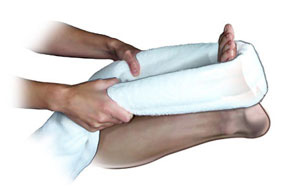
Prevention
You can take some simple steps now to prevent painful steps later.
Maintain a healthy weight. This minimizes the stress on your plantar fascia.
Choose supportive shoes. Don’t use high- heeled shoes or shoes with very low heels. Buy shoes with a low to moderate heel, good arch support and anthe ability to absorb shocks. Don't walk barefoot, especially on hard surfaces.
Don't wear worn-out sports shoes. Replace your old ones before they stop supporting and cushioning your feet. If you're a runner, buy new shoes after about 400 miles.
Warm up before starting any athletic activity or sport, and start a new exercise program slowly.
Wake up with a stretch. Before you get out of bed in the morning, stretch your calf muscles, arch and Achilles tendon by reaching for your toes and gently flexing your foot. This helps reverse the tightening of the plantar fascia that occurs overnight.
References
1. Plantar fasciitis and bone spurs. American Academy of Orthopaedic Surgeons. http://orthoinfo.aaos.org/topic.cfm?topic=A00149. Accessed Feb. 2, 2011.
2. Sheon RP, et al. Plantar fasciitis and other causes of heel and sole pain. http://www.uptodate.com/home/index.html. Accessed Jan. 27, 2011.
3. Pasquina PF, et al. Plantar fasciitis. In: Frontera WR, et al. Essentials of Physical Medicine and Rehabilitation: Musculoskeletal Disorders, Pain, and Rehabilitation. 2nd ed. Philadelphia, Pa.: Saunders Elsevier; 2008. http://www.mdconsult.com/das/book/body/208746819-6/0/1678/0.html. Accessed Feb. 2, 2011.
4. Thomas JL, et al. The diagnosis and treatment of heel pain: A clinical practice guideline — Revision 2010. The Journal of Foot & Ankle Surgery. 2010;49(suppl):S1.
5. http://www.yogaawayoflife.net/plantar_fasciitis.htm
6. http://www.footminders.com/plantar-fasciitis-exercises.html
7. http://www.sportsinjuryclinic.net/cybertherapist/front/foot/plantarfasciitis/plantartaping.php
Monday, October 3, 2011
NUTRITION WEEK 2011
DEPARTMENT OF NUTRITION,
M.V.HOSPITAL FOR DIABETES, ROYAPURAM
Nutrition is the focal point of health and well- being and is directly related to human resource development, productivity, and ultimately, to national growth. In order to provide education and to create an awareness of the importance of nutritional food habits among individuals, September 1st – 7th is observed as National Nutritional Week in our country.
It was celebrated for the first time in 1981 to highlight the problem of malnutrition which continues unabated despite significant achievements made in agricultural production, food sufficiency and industrial growth.
Malnutrition is a complex phenomenon. It is the cause and the effect of poverty and ill - health, and follows a cyclical, inter- generational pattern. It is linked with illiteracy, (especially female illiteracy), gender discrimination against the girl child, and the lack of safe drinking water and proper sanitation. It is directly linked with poverty, lack of purchasing power, food and nutrition insecurity, ignorance, and ill- health. It creates its own cycle within the larger cycle of poverty.
High levels of malnutrition, particularly among women and children, have directly and indirectly influenced mortality rates in infants, children and women. Although the country has been able to tackle nutritional deficiency syndromes such as pellagra, beriberi, scurvy and so on, chronic energy deficiency among adults, under- nutrition among children and micro-nutrient deficiencies across all sections of the population continue to be a cause of concern.
‘On the steps of nutrition lies the emancipation of the next generation - This is our vision and conviction’...
This was the theme for 2011. It was intended to address malnutrition and to generate awareness to tackle the problem through the existing health care delivery system by formulating strategies, policies and plans of action, thereby improving the nutritional status of the community.
On 2nd Sept, 2011, Nutrition Week was inaugurated at M.V.H Royapuram by the Managing Director, Dr. Vijay Viswanathan. The message of healthy eating habits was conveyed through a variety of programmes such as cooking demonstrations, puppet shows, exhibitions and film/ slide shows.
A COOKERY COMPETITION on “HEALTHY SNACKS’’ was held on the same day for the staff at M.V.H. 

Winners of the cookery competition
LET’S ADD COLOUR TO OUR LIFE BY ADDING COLOURS IN OUR DIET...
Samples of VEGETABLE CARVING by members of the Department of Nutrition.
A QUIZ COMPETITION was organized for patients on 3rd September. The theme was “A HEALTHY DIET FOR DIABETES’’ 
The participants of the Quiz competition
Winners of the quiz competition
A PUPPET SHOW was held exclusively for patients on 5th September. The theme was “SWEET LIFE FOR DIABETIC PATIENTS ’’. 
A quiz competition was also conducted for staff members. The theme of the quiz competition was “DIET AND DIABETES”
On 6th September a food court was set up where healthy snacks were sold to patients and members of the staff.
The same evening, Dr Sheba Sangeetha Jeyaraj (M.Sc., M.Phil.,NET,Ph.D), Assistant Professor, Womens’ Christian College was invited to speak on “Nutrigenomics”.
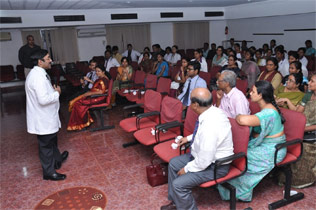
Dr. Vijay Viswanathan, Managing Director addressed the audience. This was followed by the prize distribution.
Our special thanks to the dedicated team of dietitians who organized the Nutrition Week. 
Tip of the Week

Choose the right shoe and socks